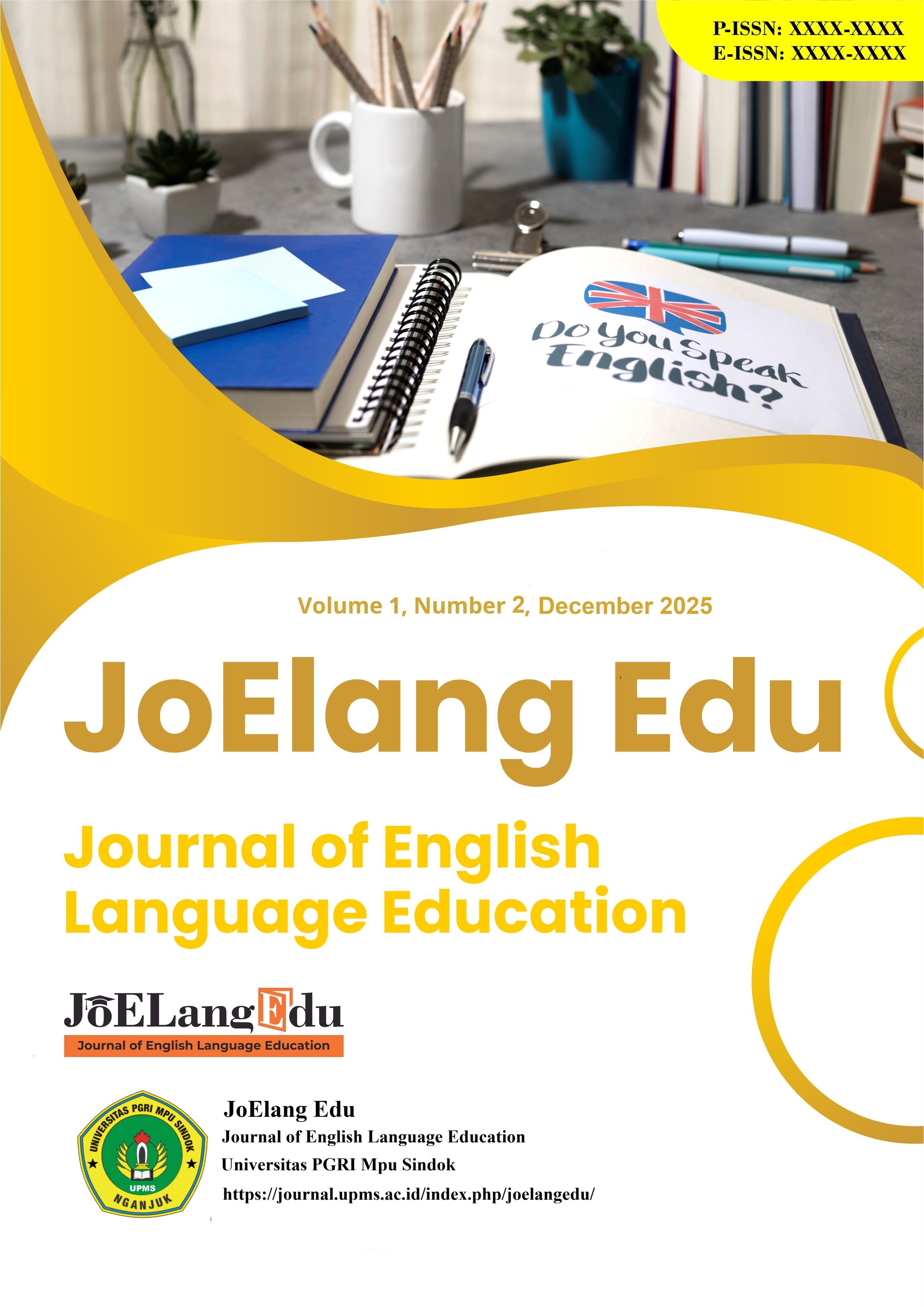
THE INFLUENCE OF WATTPAD APPLICATION TOWARDS STUDENTS’ WRITING SKILLS ACHEVEMENT OF 10TH GRADE AT SMAN 1 SUKOMORO
Keywords:
wattpad application, writing skills achievement, causal comparativeAbstract
Observations of 10th grade students at SMAN 1 Sukomoro reveal significant challenges in their writing skills, though students using the Wattpad application tend to overcome these difficulties. This research aims to (1) assess the writing skills achievement of 10th grade students at SMAN 1 Sukomoro who do not use Wattpad Application, (2) evaluate the writing skills achievement of those who use Wattpad Application, and (3) determine the significant influence of Wattpad Application on students' writing skills. A quantitative approach with a causal comparative design was used, employing Independent Sample t-Test for data analysis. Data was collected through tests and documentation from two classes: one using Wattpad and one not, with a sample of 70 students from classes 10-3 and 10-4 out of a total population of 317 students. Purposive sampling was applied. The Independent t-Test showed a tcount >ttable (9,784 > 3,980) and Sig. (2-tailed) of 0.000 > 0.05. This indicates a significant influence of Wattpad on students' writing skills achievement The findings confirms that the Wattpad application significantly influence on students' writing skills.
Downloads
References
Al Falaq, J., Suprayogi, S., Susanto, F. N., & Ul Husna, A. (2021). Exploring The Potentials of Wattpad For Literature Class. Indonesian Journal of Learning Studies IJLS, 1(2), 98–105.
Alfaki, I. M. (2015). University Students’ English Writing Problems: Diagnosis and Remedy. 3(3), 40–52.
Alisha, F., Safitri, N., & Santoso, I. (2019). Student Difficulties in Writing EFL. 2(1), 20–25.
Apriyanto. (2020). Language as a Communication in Human Life. http://ejournal.seaninstitute.or.id/index.php/Justi/index
Armawati. (2017). Increasing the Writing Skill Through Implementation of task based language teaching approach at eleventh graders SMK Wiratama Kotagajah Academic Year of 2016/2017. State Islamic Institute of Metro.
Bal, M. (2018). Reading and Writing Experiences of Middle School Students in the Digital Age: Wattpad Sample. International Journal of Education and Literacy Studies, 6(2), 89–100. https://doi.org/10.7575/aiac.ijels.v.6n.2p.89
Balla, E. (2016). A General Outlook of the Importance of the English Language in the World Today. 5(3), 499–503. https://doi.org/10.5901/ajis.2016.v5n3s1p499
Dari, T. Y. (2023). Pengaruh Aplikasi Wattpad terhadap Peningkatan Literasi Siswa Kelas XI di SMAN 8 Banda Aceh. 4(1), 1–97.
Indriani, P., Jaja, J., Kurnia, M. D., & Hasanudin, C. (2022). Utilization of the Wattpad Application to Improve Short Story Writing Skills for Students. MEDIASI Jurnal Kajian Dan Terapan Media, Bahasa, Komunikasi, 3(3), 323–337. https://doi.org/10.46961/mediasi.v3i3.604
Jusmaya, A. (2020). The Effectiveness of Using Wattpad on Development Students’ Writing Ability. IdeBahasa, 1(2), 105–114. https://doi.org/10.37296/idebahasa.v1i2.10
Khoirani, M. (2023). Pengaruh Penggunaan Wattpad Terhadap Kemampuan Menulis Teks Cerita Pendek Pada Siswa Kelas 12 IPS SMAN 12 Pekanbaru. In UIN SUSKA RIAU: Vol. (Issue 1). UIN Sultan Syarif Kasim Riau Pekanbaru.
Lubis, I. E. W. (2020). The Effect of Wattpad Social Media As Online Reading Media on Increasing Interest in Reading Fiction in Adolescents in Indonesia. Jom Fisip, 7, 1–12.
Rao, P. S. (2019). The Role of English as a Global Language. In www.rjoe.org.in An International Peer-Reviewed English Journal (Vol. 4, Issue 1). www.rjoe.org.in
Rini, J. E. (2014). English in Indonesia: Its position among other languages in Indonesia. 2(2), 19–39.
Rokha, I. (2019). Using Wattpad Application To Improve the Recount Text Writing Skill of the Tenth Graders of SMA N 3 Temanggung in the School Year of 2018/2019. Journal of Research on Applied Linguistics, Language, and Language Teaching, 2(1), 52–57. https://doi.org/10.31002/jrlt.v2i1.398
Sari, D. P. (2017). Pengembangan Menulis Kreatif Melalui Wattpad. Simposium Nasional Ilmu Pengetahuan Dan Teknologi (SIMNASIPTEK), 1–4. http://seminar.bsi.ac.id/simnasiptek/index.php/simnasiptek-2017/article/view/163/163
Sari, J. N. M. (2022). Using wattpad as a digital multimodal composing of narrative text. RETAIN (Research on English Language Teaching in Indonesia), 10(01), 100–108. https://ejournal.unesa.ac.id/index.php/retain/article/view/46190
Simanjuntak, N., Naibaho, P., Arif, S., & Medan, U. N. (2021). Pemanfaatan Wattpad Sebagai Media Pembelajaran Menulis Cerita Pendek. Prosiding Seminar Nasional PBSI-IV Tahun 2021, 1–6. http://digilib.unimed.ac.id/43369/1/Fulltext.pdf
Sukardi. (2019). Metodologi Penelitian Pendidikan: Kompetensi dan Praktiknya (R. Damayanti (ed.); 1st ed.). Bumi Aksara.
Sukriyadi, I. (2020). Penggunaan Media Pembelajaran Wattpad Dalam Keterampilan Membaca Cerpen Pada Siswa Kelas 11 Smk Prima Unggul Tangerang Tahun Pelajaran 2019/2020. Pembelajaran Wattpad Bahasa Indonesia, 1–131. https://repository.uinjkt.ac.id/dspace/handle/123456789/51727?mode=full
Toba, R., Noor, W. N., & Sanu, L. O. (2019). The Current Issues of Indonesian EFL Students ’ Writing Skills : Ability , Problem , and Reason in Writing Comparison and Contrast Essay. 19(1), 57–73.
Usman, A. H., Mahmud, A. F., Daud, A., & Dahlan, S. (2020). Language as a Social Instrument. 18(2), 257–276. https://doi.org/10.33387/Edu
Wardhani, N. A., Mufaridah, F., & Werdiningsih, I. (2019). The Effect of Using Wattpad on Students’ Writing Ability. Universitas Muhammadiyah Jember, 1510231007, 1–10.
Yashnar, S., & Ogli, T. (2020). The Importance of Language in Society. International Journal of Academic Multidisciplinary Research, 4(10), 116–118. www.ijeais.org/ijamr
Downloads
Published
How to Cite
Issue
Section
License
Copyright (c) 2025 Meira Rachmawati, Nurhamid

This work is licensed under a Creative Commons Attribution-ShareAlike 4.0 International License.
1. The copyright of any article is retained by its author(s).
2. The author(s) grant the journal the right of first publication, with the work simultaneously licensed under a Creative Commons Attribution License that permits others to share the work with an acknowledgement of its authorship and initial publication in this journal.
3. Authors are permitted and encouraged to enter into separate, additional contractual arrangements for the non-exclusive distribution of the journal's published version of the work (e.g., posting it to an institutional repository or publishing it in a book), provided its initial publication in this journal is acknowledged.
4. Authors are permitted and encouraged to post their work online (e.g., in institutional repositories or on their website) prior to and during the submission process, as this can lead to productive exchanges as well as earlier and greater citation of the published work.
5. Published articles and related materials are distributed under the Creative Commons Attribution-ShareAlike 4.0 International License.

.png)